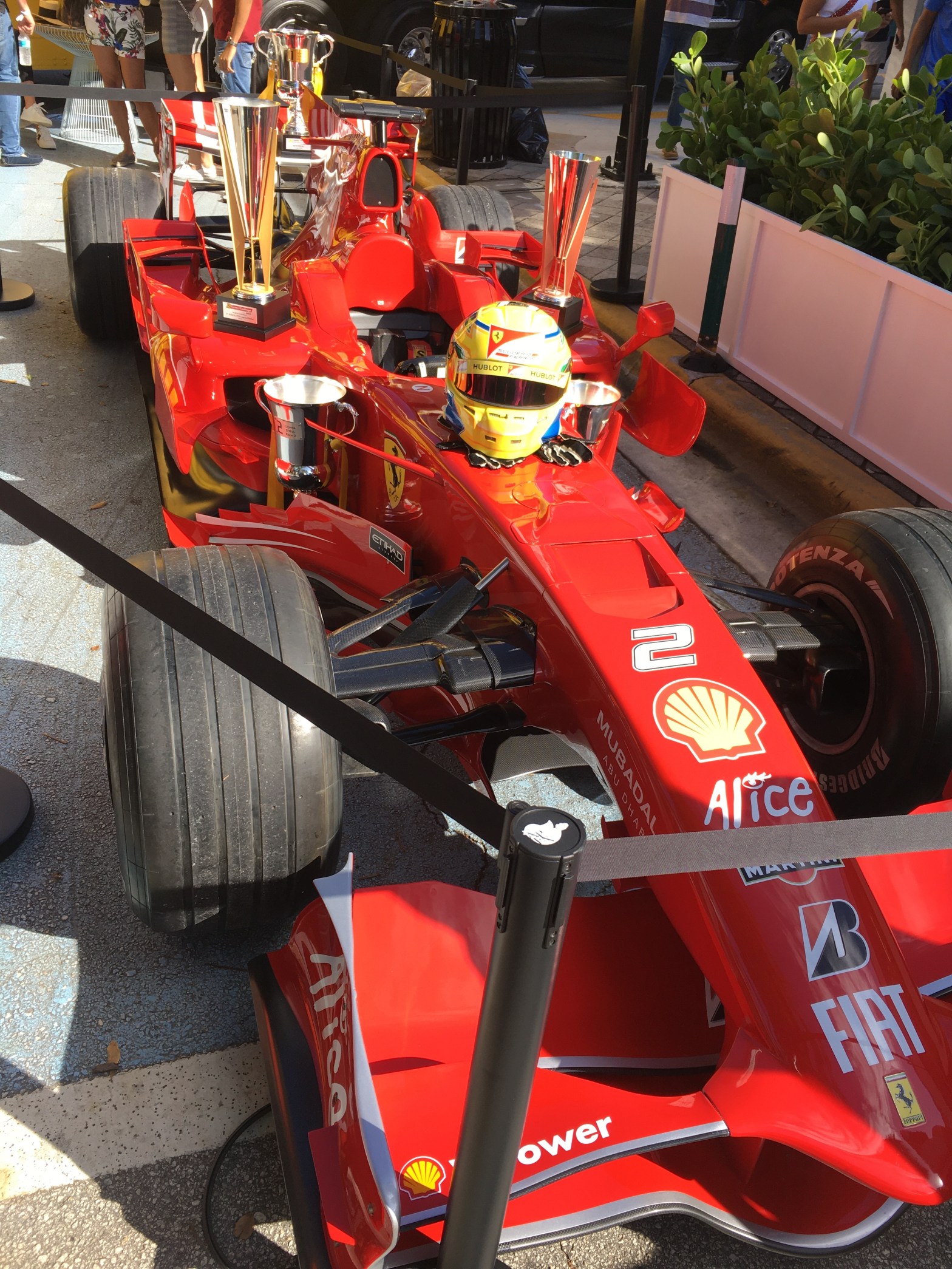
For the past 20+ years I have been obsessed with Formula1. Why? Simply put, in my opinion, it’s the only sport with a unique combination of highest speeds, most advanced technology, fittest athletes and crème de la crème glamor.
First of all, what is Formula1, or F1 as it’s called? To quote wikipedia, ‘F1 is the highest class of international auto racing for single-seater formula racing cars sanctioned by the FIA’ and ‘One of the premier forms of racing around the world since its inaugural season in 1950.’
High speeds: Let’s get the straight line speeds out of the way first: 223mph (360km/h). 0-60 in 2.6 seconds and engines revving at up to 15,000 rpms. 8 gear shifts. Nuf said. However, the most unique aspect of an F1 car are the corner speeds and the lateral ‘g’ loads that they put on the necks of the drivers – more on this later.
Unlike Nascar, where the tracks are oval, an F1 race track has anywhere between 15-20 corners with some being very high speed (180 mph at Silverstone’s Copse ‘corner’) and some low speed (as low as 30 mph at Monaco’s famous Fairmont Hairpin). At the high speed corners, the g-loads – 1 g is what we experience when standing on the ground – can be as high as 6 g! This has another interesting implication though, if the car is being pulled out of the corner by 6 times its own weight, then in order to stay firmly planted on the ground, it’s downforce needs to be even higher than that! And that’s what the entire aerodynamic system of the car tries to do – to keep the car planted on the ground with more than 6 g-force. The cars must surely feel heavy and grounded at high speeds. Another interesting trivia from this is that theoretically the car can travel upside down in a tunnel and still be fine!
Advanced Technology: What’s amazing to me is that every year the cars are designed to a certain specification by independent manufacturers. The cars are designed and built in extreme secrecy to avoid leaking any innovations and tricks to their competitors. And yet, when the cars arrive at the first race track of the year, the differences in the top 5 is usually under a few 100 ms. That’s a blink of the eye!
Being a big data person, one of the most fascinating aspects of the F1 cars is the amount of data they stream out for analysis. If there was a competition for the most data-driven sport, F1 would win hands down. The cars are loaded with approximately 300 sensors which collect all types of data such as oil pressure, tyre temperature, fuel loads, wind pressure etc. This data – approx 3 to 5 GB worth – is streamed back to the race garage where it is analyzed in near real time to make decisions about the race strategy, pit stop timing, and other safety protocols. In addition to this data, the car also stores further logs about the performance of every component and when the car is back in the garage, that data is off loaded for post-race analysis. Back at the factory, engineers also use this data combined with other data from the wind tunnels and dyno to understand the performance of the car, trying to eke out even 10 ms more.
Fit Athletes: F1 athletes are some of the fittest athletes amongst any sports. They not only train in the gym with weights etc., but add other activities to their training schedule – some are marathon runners, some are long distance cyclists, and many others participate in similar competitive endurance events. On a hot day with temperatures reaching above 100 F, these athletes have to maintain full concentration under the heavy g-loads for approximately 2 hours (normal race time) while wearing their fireproof vests! It’s normal to lose 4-5 lbs of fluids in sweat on race days. The lateral g-loads means that the drivers need to especially train their neck muscles by using special harnesses to lift weights with their necks!
Glamor: F1 races are held in some of the most vibrant cities around the world. Austin (USA), Sao Paulo (Brazil), Barcelona (Spain), Melbourne (Australia), Montreal (Canada), Baku (Azerbaijan), Singapore (night race!), and the cream of glamor – Monaco, to name a few. Pre-race shows include performances by world famous musicians and artists. The drivers themselves are celebrities in their own right and any sessions with them such as pre-race interviews, autograph signing etc. are sold out. Most races are also attended by local and international celebrities.
So, there you have it. My first blog post, and personal reflections on why this sport has captured my attention for over 20 years! More on F1 coming soon…
Cheers
Abhi Khune
Abhiram Ganesh Khune
 Musings by Abhi Khune
Very interesting. Lots of things about which I had no idea.
LikeLike