
In my previous blog post, I mentioned a few intriguing questions such as ‘How do we measure the distance to other stars in the Milky Way?’, ‘How do we measure the distances to far away galaxies?’ etc. And in another blog post, I posed several other interesting questions such as ‘What is the Big Bang?’, ‘What is Dark Energy?’, ‘What is Dark Matter’ etc.
Let’s answer these in this blog post! Let’s make a few observations first:
- When light from distant stars and galaxies reaches our eyes (and our telescopes), it presents the state of that object when the light left that object. So if it took 1 year for that light to travel to us, then we are seeing the star as it was 1 year ago. And the farther a star is from us, the longer it takes light from that star to reach us. In other words, when we look into the night sky, we are looking into the past!
- Doppler effect: When the source of a wave (of light or sound) is moving towards us, the waves get bunched up (i.e. the wavelength is shortened) and similarly, if the source of the wave is moving away from us then the waves get stretched out (i.e. they have a slightly longer wavelength than the wavelength as observed by an observer right near the source). And, in the spectrum of light waves (imagine a rainbow), the blue end of the spectrum is the shorter wavelength and the red end of the spectrum is the longer wavelength. So if a star is moving towards us its light would be blue-shifted, and if it’s moving away from us, its light would be red-shifted.
Distance ‘ladder’
Scientists have devised various methods to measure the distance to nearby stars and far away galaxies. These methods build on top of each other, hence the name ‘ladder’. Essentially, we have method #1 for measuring the distance to nearby stars, and another method #2, which builds on the method #1, to measure farther away stars and so on.
Method #1: Parallax
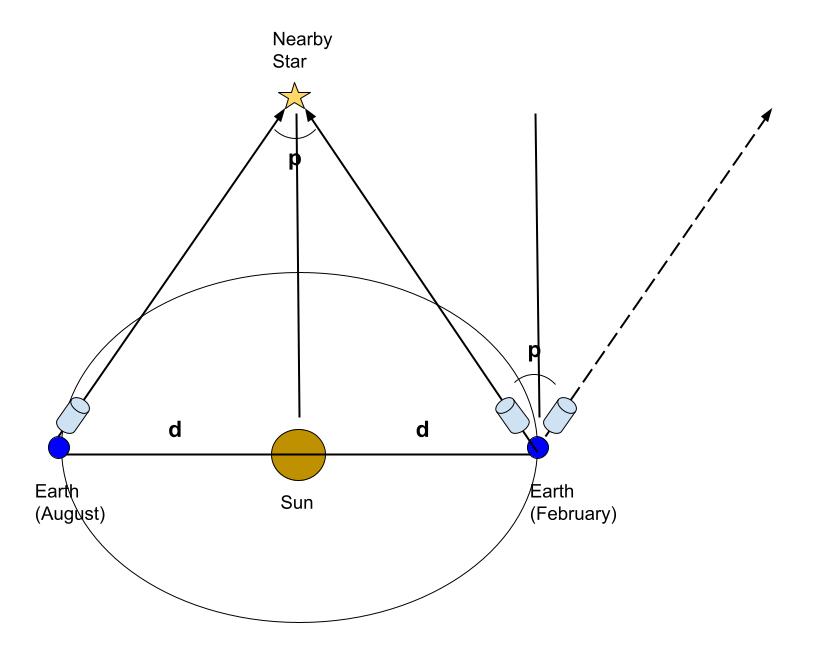
Parallax is the perceived change in position of an object seen from two different places. We aim our telescopes onto a star and as the Earth revolves around the Sun, we measure the change in the angle of the telescope, and given that we know the diameter of Earth’s orbit around the Sun, we can calculate the distance to that star!
Method #2: Cepheid stars (discovered by Henrietta Leavitt, an astronomer from the early 1900’s!)
Cepheid star is a type of star that pulsates, i.e. it expands and contracts, and has the property that the larger the star the longer it takes to expand and contract. So if we observe a pulsating star, just from the expansion and contraction duration, we can figure out the size of the star. Another property of the cepheids is that the luminosity to its observed brightness is proportional to its distance to us. So if two cepheids are pulsating with similar frequencies then their luminosities tell us their relative distance. And typically there are 1 or more cepheids in every galaxy. Thus, if we can observe a cepheid in a our galaxy or a nearby galaxy, we know its distance with method #1, then we can figure out the distance of farther away galaxies with cepheids in those galaxies with similar pulsating frequencies.
Method #3: Type 1a supernovae
This is a somewhat rare phenomenon, where if two white dwarf stars orbiting one another collide and form a mass greater than 1.4 times the mass of our Sun then they reignite and form a massive and very bright explosion, called a supernova. (The 1.4 times the sun’s mass, below which a white dwarf star is stable, and above which it’s not, was a calculation done by an Indian astronomer Subrahmanyan Chandrasekhar, and hence is known as the Chandrasekhar limit). The two interesting properties of a Type 1a supernovae are that a) they have a fixed time of explosion, about 20 days from start to peak luminosity, and b) the peak luminosity is the same for all Type 1a supernovae irrespective of the galaxy it was in. Which means that if we observe these supernovae multiple times over a course of several months, based on the luminosity and given method #2, we can figure out the distances to the very remote galaxies.
Another bizarre observation that the scientists made from observing galaxies all around us was that every galaxy seemed to be red-shifted, i.e. every galaxy around us seemed to be moving away from us. Clearly, we are special, but not that special that we are the center of the universe and that everything is moving away from us 🙂 This led to the conclusion that everything is moving away from everything else. This led to the obvious conclusion that if everything is moving away from everything then in the past it must have been closer to everything else. And in the very very past it was much closer to each other and at the beginning of time, it was all on top of each other. In others words, this led to the theory of the Big Bang, that the universe started as a very small thing and then has been expanding ever since.
If that was bizarre for scientists to discover, here’s the punchline that took them by massive surprise: Scientists wanted to measure this expansion rate and wanted to see when the expansion would stop, and perhaps reverse and head towards a ‘big crunch’. So if they measured the distances to far away galaxies, and measured those distances over several months and years, then they would hopefully see the deceleration of the galaxies. To their massive surprise, the far away galaxies were moving faster than the nearby galaxies. In other words, the distance between us and the nearby galaxies was increasing but the distance between us and the far away galaxies was increasing at a higher rate! This means that the universe is not only expanding, it’s actually accelerating in its expansion!! This discovery in 1998 won the Nobel prize in physics and it is one of my personal favorites of Nobel prizes in physics.
So, let’s catch our breath and summarize: We humans, on a tiny planet of a somewhat modest star amongst 100s of billions of stars at the fringes of a galaxy, which in itself is one amongst 100s of billions such galaxies, have observed the faintest of lights (photons!) coming to us from all over the universe, and have deduced that the universe started with a Big Bang, we can measure distances to distant galaxies in ‘light years’ and that the entire universe is expanding and accelerating in its expansion! Pretty remarkable.
So that leads to the very next question: What in the world is making the universe accelerate in its expansion? Because, if you think about it, if you threw several balls in the air with different forces, then they would initially fly away but due to gravity will slow down, and eventually fall back down. If they were to keep going, and not just keep going, but accelerate away from you, then that means some force was pushing them. And that force would be greater than the gravitational force. This mysterious force is called Dark Energy.
Our best guess at this point is that this force always existed in the universe, and may have caused the Big Bang in the first place. Later in the expansion of the universe, the gravitational forces balanced it out a bit, and now it is dominating again and pushing everything apart. Ironically, Einstein, when he wrote down the equations for his new theory of gravity, Theory of General Relativity, in early 1900s, thought that the universe should stay stable (and should not expand or contract), and so he put in a term in the equations to counter the gravitational force which would have otherwise contracted the universe. And this constant term was called the Cosmological constant. So our best guess right now is that Dark Energy is the Cosmological constant. The ironic part is that since this energy, sometimes also called the vacuum energy, is presumed to be a constant, and as the galaxies go farther from each other, the vacuum between them grows, and thus the Dark energy increases! Thus accelerating the expansion of the universe even more! This means that soon (in several 100 billion years) all galaxies would be so far away from each other that we would not see any galaxies (which appear to us as faint stars) in the night sky apart from the Milky Way stars. (You might be wondering if the law of conservation of energy is till holding if the vacuum energy is seemingly arising out of nowhere, then ‘no’, as the galaxies are moving apart their gravitational pull is decreasing and scientists believe that this balances the increased vacuum energy).
Phew, that was a lot for this blog post. Stay tuned for more on such topics in a future blog post! Till then…
Namaste
Abhi Khune
Abhiram Ganesh Khune
 Musings by Abhi Khune